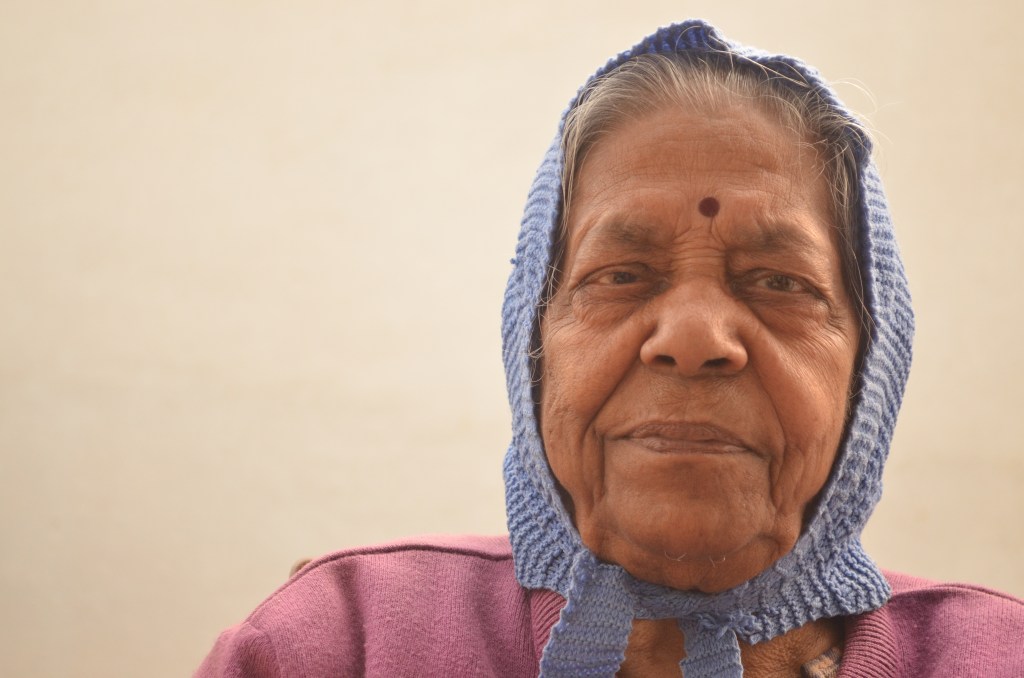
For some reason, what I remember most vividly about her is her eyelids. They reminded me of aam papad. The sweet, moist snack made of mangoes and sugar syrup. As I begrudgingly lay next to her for our afternoon nap, she often narrated an old folklore to me, with her forearm placed on her forehead.
Dadi was always there. The red glass bangles around her wrists were held together by a safety pin. In idle moments, she often used the same pin as a toothpick. As a child, I once asked her not to do it, lest she accidently prick her gums. She nodded, but never stopped doing it. My first memory of her is from our house in Soami Nagar. The long ceiling fan hung low, its blades moving ever so slowly in the summer heat. The sun took over the courtyard as Dadi shuffled in and out of the room, while I tried hard to finish my bottled milk. In the evenings, we dashed to Pari Lok, the children’s playground, and spent our time rolling in the grass or selling make-believe paan (betel leaves with fake gulkand made of muddy water).
Dadi was always there. Most days, we barged into the house after school, and the first thing she did was unfasten our name-tag from our tunics. She called it ‘billa’, much to our amusement. Then she would fold our clothes, keep our shoes and socks aside and lay the table for lunch. Most late afternoons were spent either painting, writing a story, or my brother and I singing the latest Bollywood songs to Dadi, who was an agreeable listener. She had a little cassette player that often had me crooning along with Lata Mangeshkar or Asha Bhosle. One of my favourites was Dil ka bhanwar kare pukaar, pyaar ka raag suno re. Dadi never sang along, but she always insisted on me singing for her.
To me, Dadi wasn’t just my grandmother, but she was also my Hindi teacher. Every evening, I would sit with her for an hour with my textbooks. It didn’t matter if it was poetry, or Premchand’s books, or short stories. Whatever she taught me would get imprinted in my mind in a way it never could when my school teacher read it out in class. The words she used, the pathos she created and the way she made me understand every word made everything clear as day. It was because of her that I fell in love with the language, which to me always seemed functional and boring.
Dadi was always there. When we expected guests, she sat in front of her little dressing table with a movable mirror affixed to it. She usually donned a crispy cotton saree that she pinned on her shoulder with a big safety pin. She would oil her hair and braid it patiently. She always wore two black pins, one on each side of her head. She smelled of Boroline, coconut oil, camphor and talcum powder. To this day, I can’t smell Boroline without thinking of her. I think of her sitting on her bed knitting a sweater or embroidering cushion covers or watching ‘Waqt ki Raftaar’ on Doordarshan.
As a woman growing in the ‘40s, she managed to do something only a handful of women could do back then. She went to college. Not only that, she even did her MA, and then got herself a Ph.D degree. She became a professor of Hindi and Economics and later became the Hindi department’s head. I always felt extremely proud that she carried the ‘Dr’ tag in her name. Dr. Vidyawati Verma. An alliteration that still rings sweet in my ears. She raised three kids, and for 67 years, she slept in the same bed as my Baba. We all sat together at the same table for lunch, and Baba Dadi drank from their personalised steel glasses with their names engraved on the sides in big, bold letters. Baba’s glass was bigger and more imposing, Dadi’s was reasonably sized and slightly narrower. While Baba Dadi went about their days peacefully, they had the occasional squabble, that always began with a loud “Arre Bidyaaaaa!” from Baba.
Dadi was always there. I remember the day I thought there was a snake in the house. Since there were no elders home, she came downstairs, bravely armed with a wooden stick and a big, red brick. As she went ballistic on the snake, I remember admiring her heroism while I hid behind the sofa. The fact that the ‘snake’ turned out to be a piece of paper is another story altogether.
Out of all the tales she used to narrate, my favourite was the one about a king married to two queens – Nagvati and Padmavati. It was a crazy story about ring-eating fish and a talking parrot made of gold. But I would have heard her retell the story a million times. She never said no. Come to think of it, she never said no to anything.
She never expressed her affection openly, but when she did, it usually entailed two big, splotchy, noisy kisses on both cheeks. I never liked it back then. What I did like were her lullabies. There was one about a child sleeping on a ‘laal palang’, or a red bed. I always asked her ‘Why can’t the bed be yellow or blue or green? Why red?’ So, every time she sang it, she chose a different colour.
Dadi was always there. To stitch clothes for our toys, to help us with our homework, to offer a hot cup of chai with some rusk, cream, salt and pepper, and two Marie Gold biscuits. To join us in our celebrations, to make fruit cream, to apply Boroline on our wounds, to give us marks on our latest painting, to usher us to the bed for yet another afternoon nap. She was always there, and now that she isn’t, my heart doesn’t feel like it’s in the right place. Nothing seems to be in its right place. And yet, we all go to work, we sit at the table and eat, we pay our bills, and our hearts beat with the humdrum rhythm of life.
Baba always told Dadi he wouldn’t leave before her. “Main tumhe bhej ke hi jaoonga,” he would often tell her. In her heart, she knew he was way more obstinate than her. He had even taken her farewell clothes out and kept them neatly in their almirah. Hers and his, in separate packets. Because even after 67 years of togetherness, we all go home alone.
Dadi was always there. And even though she isn’t anymore, she’s still there in that little room. She’s still there, braiding her hair and pinning her saree. She’s there, listening to Lata Mangeshkar and lying on her bed with her forearm over her forehead. She’s still using her safety pin as a toothpick and asking us to remove our billas from our tunics. She’s still teaching me the difference between ‘arthaath’ and ‘bhavarth’. Dadi, her red bangles and her aam-papad eyelids still live on in our memories. And her steel glass, like our hearts, will forever be etched with her name in big, bold letters. Dr. Vidyawati Verma. We will always be grateful to you. Rest in peace, Dadi.



 Butterflies and Hurricanes
Leave a reply to Manish Kumar Cancel reply