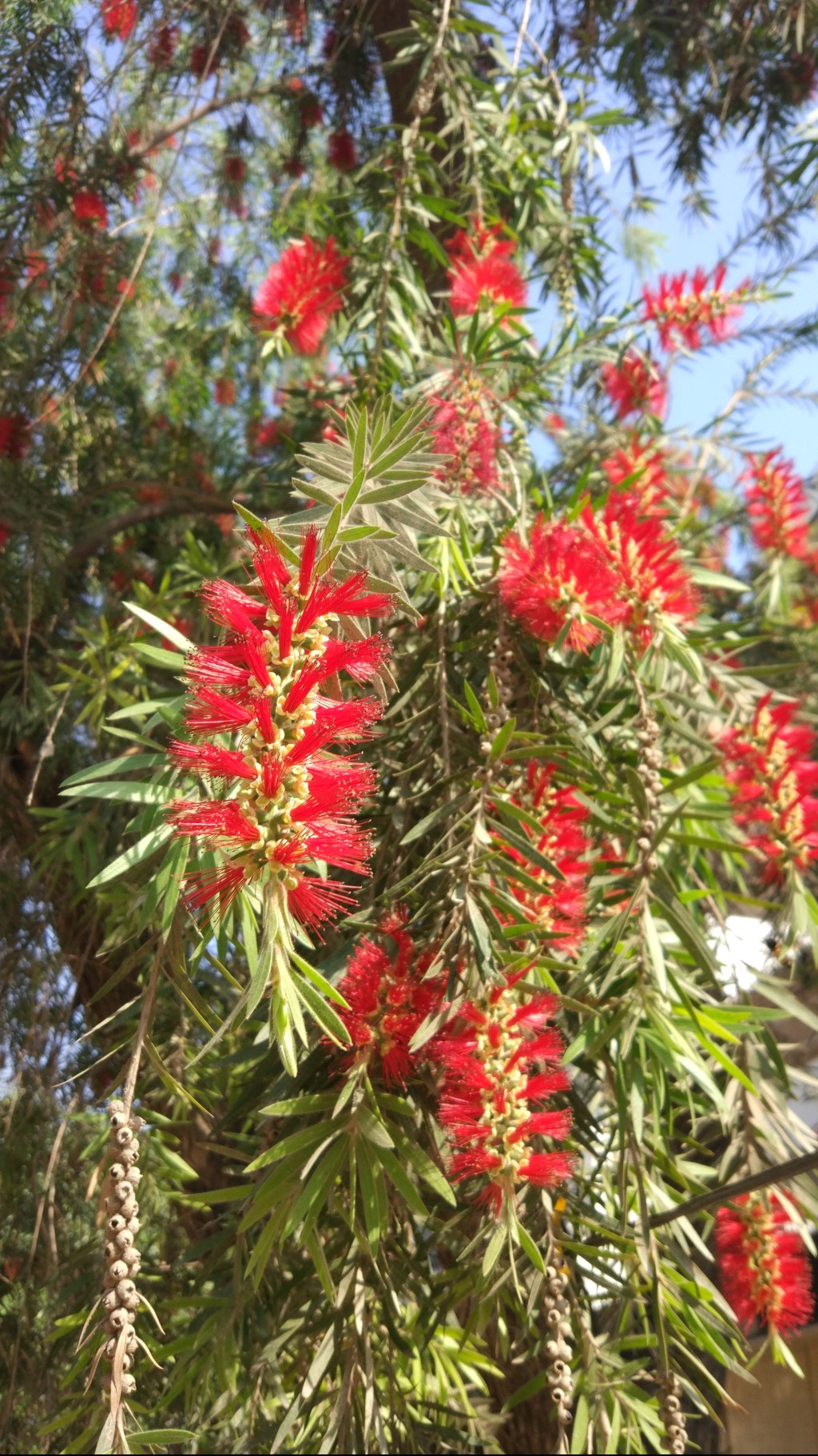
There is a bottle brush tree right outside our house here in Agra. It owes that peculiar name to its shape since it looks like a traditional brush used to clean bottles. Not very imaginative, I know. A quick search on Google revealed its true name: Callistemon.
Callistemon.
I like how it feels inside my mouth. I like how the tip of my tongue hits my upper teeth, then the roof of my mouth, and then how my lips come together in its culmination. I prefer to emphasise the ‘mon’ instead of the ‘te’. The Indian inside me finds it more natural to do so.
Do you think about how magical springtime is? The entire world is sprouting and blooming. The streets are lined with flowers of all shapes and hues, bees and butterflies are buzzing about, there are fragrances mingling with the balmy summer sunlight in the evenings. The roads are flanked by the most gorgeous shades, and often covered in a thin layer of freshly-fallen leaves. Everything is a little more cheerful, a little more crispy, a little more alive.
When I was growing up, we had a Kachnar tree right next to the Callistemon tree. They both blossomed together, standing tall, self-assured, confident. Their leaves would merge with each other’s, and sometimes their flowers fell together in unison. Maybe in their world, they were great friends. I’d like to believe they were.
I’d never seen a flower more beautiful than the Kachnar. It had five petals, four of them light purple in colour, and then one bright pink, almost electric purple. There were five slender filaments in the centre, topped with bright yellow anthers. We often used them to play our own silly games. We’d pick a filament each, and then entangle the anthers together. The one that got decapitated first, lost. I sometimes plucked a few flowers for Dadi. She’d tie the stems with a white thread and display them in an old, brass vase. The vase was so worn out you couldn’t even make out the design on it anymore. Maybe old kings and queens? I never cared enough to ask.
My brother and I would climb up the Kachnar tree – all the way to the topmost branches – with polythene bags tied around our wrists. We were like adept monkeys, and over the years we perfected our way around it. We knew where to place our feet, we knew which nodes to use to haul ourselves up, we knew the branches that could support our weight. We’d collect the buds that were yet to sprout open, even the tiniest ones, and ran up to Dadi with bags full of them. She’d then use them to make a special curry for us, with sliced potatoes and onions. Kachnar ki sabzi. We’d be proud of ourselves. We’d contributed to the economy of the household!
A few years ago, some of its branches started enmeshing with some of our electric cables, and so we had to chop off some of the branches. They did a horrible job. They removed more than what was needed. It was like a haircut gone wrong, only much, much worse. The next spring, the Kachnar tree didn’t bloom. It was as if we had destroyed a part of its soul. “Maybe it’s just been a bad year”, I thought. “It’d be alright.” But it didn’t bloom the next year, or the next. It never bloomed again. All that remained was a bare stump. And later, that was demolished as well.
I can’t say I don’t miss it. Even now when I visit home, my eyes rove over its usual spot. I long to see those purple petals again, I miss the tantalising smell, I think about the heart-shaped leaves (that often doubled up as betel leaves when we set up a make-believe Paan Shop). I sigh. I think about how it formed such a major chunk of our childhood, and how I’d never see it standing there in all its glory, its feathery petals falling gently underneath.
I was in New Delhi last week, and I saw a Kachnar tree after many years. I felt a maudlin sense of joy enveloping my heart. “Hey you”, I thought. “It’s been a while.” It swayed and sashayed in response. I smiled. Seeing it in full bloom again restored my faith in the powers of spring all over again. My Kachnar tree doesn’t blossom anymore, but many Kachnar trees outside many little girls’ houses still do. And that was as reassuring a thought as any.
Now, as I stand outside and look at the Callistemon tree, it fills me with the same sense of awe. The red petals that look like paint brushes, the powdery yellow tips, the way the crimson looks so stark against the natural green of the tree. The bees are abuzz, the birds visit often – loud and cacophonous, and the sunlight ripples and dances through the branches. Maybe it realises that its friend isn’t around anymore. Maybe it misses the soft touch of its branches. Maybe they had their own conversations many moons ago. Maybe trees love being caressed. I walk up to the tree, run my fingers along the leaves and the length of the flowers.
Three simple words run through me. Words that have helped me cope. That have helped me stand. That have helped me bloom.
“I’ve got you,” I find myself whispering.





 Butterflies and Hurricanes
Leave a comment